
Saving $1,000 in 30 days sounds like one of those internet promises that falls apart the moment rent is due. But strip away the hype and the math is surprisingly ordinary: you don’t need a raise, a windfall, or a month of eating rice. You need about $33 a day — and there are only three ways to find it: spend less, earn more, or sell what you already own.
This guide breaks the $1,000 into a week-by-week plan that real people actually finish. No 40-hour side hustle. No “just stop buying coffee” lectures. Just a sprint with a finish line.
The $1,000 breakdown (your three buckets)
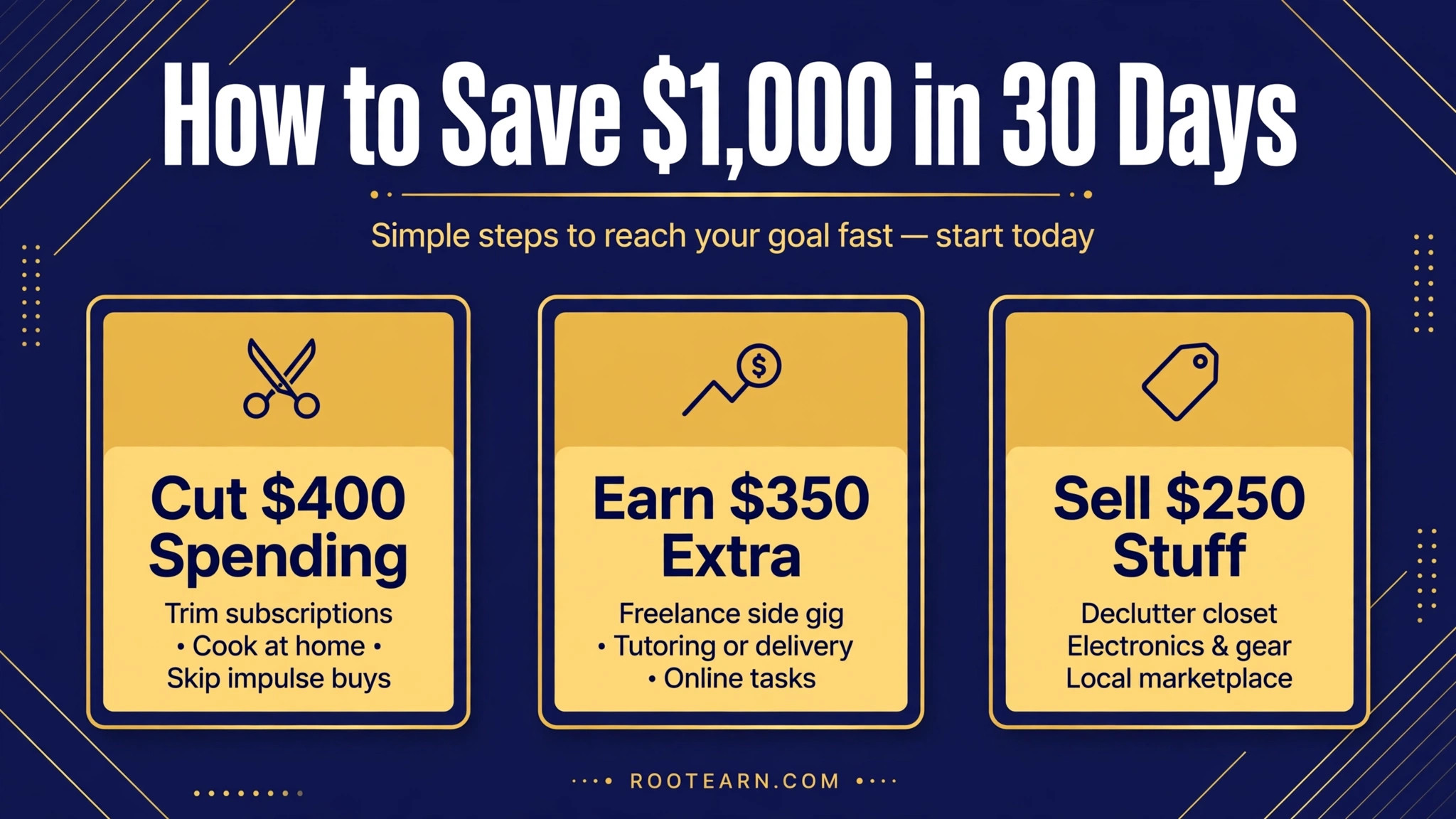
Forget saving $33.34 every single day — that’s not how real life works. Instead, split the goal into three buckets:
| Bucket | Target | How |
|---|---|---|
| Cut spending | $400 | Subscriptions, food, impulse buys, negotiated bills |
| Earn extra | $350 | Gig work, freelancing, cashback |
| Sell stuff | $250 | Clutter you haven’t touched in a year |
| Total | $1,000 |
Three buckets means three ways to win. Fall short in one, make it up in another.
Week 1: Stop the leaks (Target: $250)
Week 1 is about money you’re already losing. It requires zero extra hours of work.
Day 1–2: Cancel and pause. List every subscription — streaming, apps, gym, boxes, memberships. Pause or cancel all of them for 30 days. Most people carry subscriptions they barely use, and pausing them for one month typically frees $75–$150. (A free budgeting app makes the forgotten ones visible — see our best free budgeting apps compared for 2026.)
Day 3–4: The pantry and freezer week. Eat what you already own for as many meals as possible this week. Eating out is one of the biggest flexible expenses for most households — one disciplined week of home cooking can save $100–$150.
Day 5: Negotiate one bill. Call your internet or phone provider, say you’re considering switching, and ask for a better rate. Success rate is high and it takes 15 minutes. Typical win: $20–$60/month — count the first month toward your $1,000.
Day 6–7: Photograph 20 things to sell. Walk through your home and photograph 20 items you haven’t used in a year — electronics, clothes, furniture, tools. Don’t list them yet; just get the photos done. This is next week’s fuel.
Week 1 expected total: $200–$300 without working a single extra hour.
Week 2: Sell the clutter (Target: $250)
Day 8–10: List everything. Put those 20 items on Facebook Marketplace and eBay. Price 10–15% below comparable listings for fast sales — speed beats squeezing every dollar in a 30-day challenge. Old phones, consoles, furniture, and brand-name clothes move fastest.
Day 11–14: Follow up and drop prices. Relist anything unsold with a lower price. Bundle slow movers (“3 jackets for $40”). List 20 decent items and clearing $200–$350 in two weeks is a realistic outcome.
Running total after Week 2: $400–$650. You’re nearly halfway without a side hustle.
Week 3: Earn the gap (Target: $250)
If selling covered you, Week 3 is a cushion. If not, this is where you close the gap.
- Gig apps with instant pay: Food delivery or grocery apps can pay $12–$30/hour with tips, and many offer same-day payouts — see our list of gig apps with same-day pay. Two focused weekend shifts (10–12 hours) can add $150–$250.
- Cashback on spending you already do: If you’re buying groceries anyway, run them through cashback apps. It won’t make you rich, but our survey sites vs cashback apps breakdown shows which ones are actually worth the taps.
- One freelance task: Writing, design, data entry, transcription — a single small gig on a freelance marketplace often pays $50–$200. Our best side hustles for 2026 ranks options by real pay.
Pick one. Depth beats scattering yourself across five apps.
Week 4: Protect it and finish (Target: $150–$250)
Day 22–25: Final push — one more selling round, one more gig shift, redeem any cashback balances.
Day 26–28: Move the money. This is the step everyone skips. Transfer the full amount to a separate high-yield savings account — not the checking account you spend from. Money you can see gets spent; money with a little friction survives. Compare current high-yield savings rates and park it there.
Day 29–30: Count and lock it in. Tally everything. If you landed at $850 instead of $1,000, that’s still an $850 emergency fund that didn’t exist a month ago. Then decide: keep the habits that were painless, drop the ones that weren’t.
What NOT to do
- Don’t raid retirement accounts. A 401(k) withdrawal costs you taxes, penalties, and decades of growth for a short-term goal.
- Don’t finance the challenge. Buy-now-pay-later and credit cards turn a savings sprint into a debt spiral — the opposite of the goal.
- Don’t try to be perfect. Missing one no-spend day doesn’t fail the challenge. Quitting does.
FAQs
Can you really save $1,000 in 30 days on a low income?
Yes, but the mix shifts: more weight on selling and cutting, less on “just earn more.” Even $5/day is $150 in a month — start where you are and scale what works.
Where should I keep the $1,000 once I save it?
A separate high-yield savings account. It earns interest while staying out of spending reach — exactly what an emergency fund should do.
What if I only save $600?
Then you built a $600 emergency fund in 30 days, which puts you ahead of the ~40% of Americans who couldn’t cover a $400 emergency. Run the challenge again next month.
Ali Zain is the founder and writer behind RootEarn, where he researches and publishes practical guides about personal finance, side hustles, saving, and online income.
Once you’ve saved your first $1,000, the next step is building a full emergency fund — here’s how much you need in 2026 and where to keep it.
Related reading
The math that makes it work
One thousand dollars in 30 days is $33.34 a day, or about $234 a week. That framing matters: you are not looking for one big windfall, you are looking for four repeatable weeks. Most people fail because they aim for a dramatic cut in week one and quit by week two.
Four levers, in order of speed
- Sell what you already own. Unused electronics, furniture, tools, brand-name clothing. This is the fastest lever — most households can find $150–$400 without touching their income.
- Cut recurring charges. Cancel unused subscriptions, downgrade plans you barely use, and call your internet and phone providers to ask for a lower rate. One 15-minute call can save $20–$40 a month.
- Add short-term income. One extra shift, a weekend task, tutoring, delivery blocks, or freelance work you can finish in an evening. Even $80 a week closes a third of the gap.
- Automate the transfer. Move the money the day it arrives. Savings that stay in your checking account get spent.
Week-by-week plan
Week 1 — $250: audit the last 60 days of spending, cancel three subscriptions, list five items for sale. Week 2 — $250: sell the rest, ask for one bill reduction, pick up one extra shift. Week 3 — $250: repeat the best-performing lever, skip one category of discretionary spending entirely. Week 4 — $250: final push on sales and extra hours, then move the total into a separate account the same day.
What derails the challenge
Three things: keeping the money in your main account, cutting categories you actually enjoy (which triggers rebound spending), and counting money you have not received yet. Track only what has landed in the savings account.
Once the $1,000 is saved, decide what it is for before you touch it. If it is a first emergency buffer, our emergency fund guide shows how much you actually need and where to keep it.