
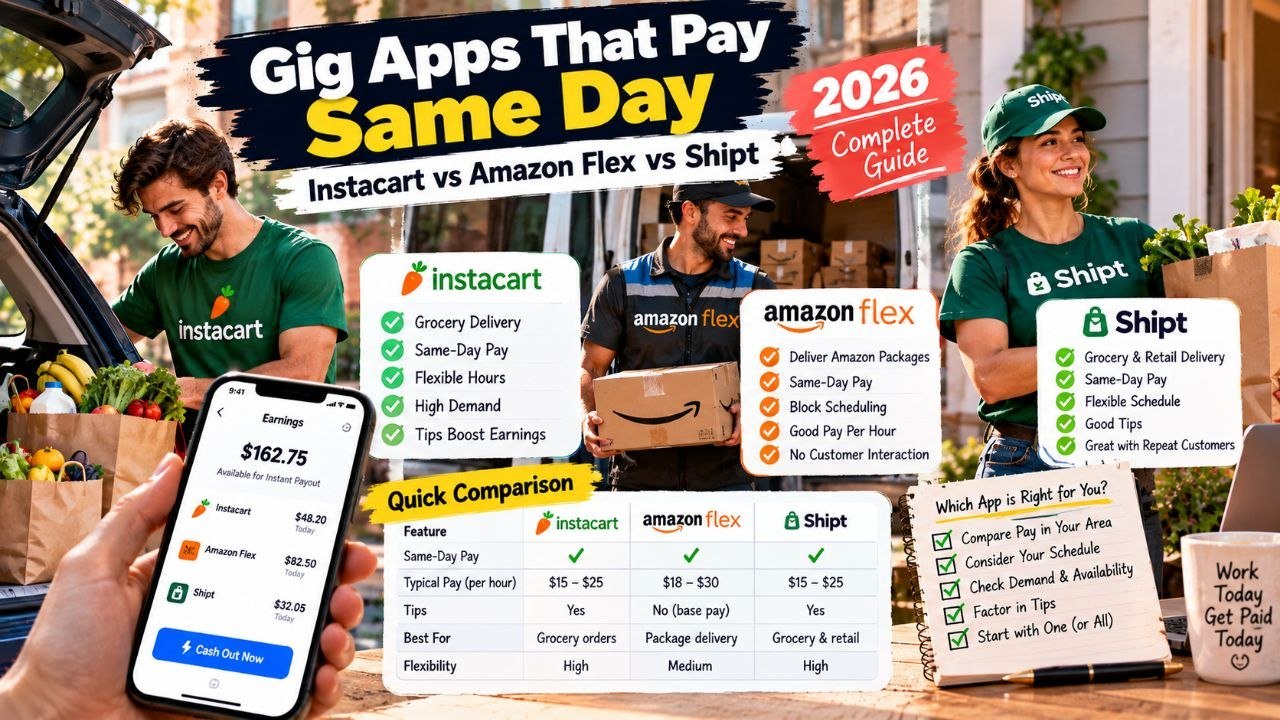
Search “gig apps that pay same day” and you get a wall of screenshots: a $172 Instacart day, a $210 Flex block, a $95 Shipt morning. What those screenshots never show is the part that actually decides whether you get cash today or next Tuesday — how each platform moves money from your in-app balance to your bank account.
Instacart, Amazon Flex and Shipt all pay you the same way in principle: you complete work, the platform credits your account, and a deposit happens on somebody else’s schedule. The difference is what happens in between. This guide breaks down exactly how same-day pay works on each platform in 2026, what the speed really costs, and how to pick the one that matches your cash flow instead of your Instagram feed.
First, Untangle Three Different Things People Call “Same-Day Pay”
Most confusion about gig pay comes from smashing three separate ideas into one phrase:
1. Platform pay schedule. When the app automatically deposits the money you earned — weekly, twice weekly, or on demand.
2. Instant cashout. A feature that lets you push already-earned money to a debit card within minutes, usually for a flat fee per transfer.
3. Tip timing. Tips frequently clear after the order or block finishes, which means they may not be part of your balance when you tap cashout.
Only #2 is genuinely “same-day.” If you are choosing a platform because you need money today, you are really shopping for an instant cashout feature — and you should look at its fee, its limit, and how fast tips actually settle on that specific platform.
Instacart: Instant Cashout, Flat Fee Per Transfer
Instacart shoppers are independent contractors paid per batch. Earnings build up in the app and the default option is a weekly direct deposit — reliable, free, and slow if rent is due tomorrow.
Instacart also offers Instant Cashout, which moves cleared earnings to a debit card within minutes. The mechanics matter more than the marketing:
- You pay a small flat fee per transfer — not a percentage. The exact amount is shown in the app before you confirm, and it can change, so check it rather than trusting a number from an old article.
- It applies to cleared earnings only. If a batch is still being processed, that money is not cashout-able yet.
- Tips can settle later than batch pay, which is the most common surprise. You finish an order, see the batch pay available, cash out, and the tip from the same order lands afterwards — in a later transfer.
- Cashouts are typically limited to a set frequency and a minimum balance, so it is not an unlimited ATM.
Best for: shoppers with unpredictable expenses who occasionally need a specific amount of cash mid-week and are fine paying a small fee for it.
Amazon Flex: Twice-Weekly Deposits, No On-Demand Cashout
Amazon Flex works differently from delivery-apps-with-tips because you reserve blocks in advance rather than accepting live offers. You know the pay before you accept, which makes Flex the most predictable of the three for per-hour math.
The trade-off is payout speed. Flex does not offer an instant cashout option. Earnings are deposited on a fixed twice-weekly schedule — commonly Tuesday and Friday, covering work completed in the prior period. Grocery and Whole Foods blocks can include tips that are added after delivery, and those may land in a later cycle than the block pay itself.
What that means practically: Flex is a schedule, not an on-demand wallet. If your bills are irregular, you plan around the deposit days — you do not get to pull money forward.
Best for: people who can work around fixed paydays, prefer upfront per-block rates, and value fewer trips over more offers.
Shipt: Weekly Pay Cycles and the Tip Lag Trap
Shipt shoppers claim orders, shop them, and get paid on a weekly direct-deposit cycle in most cases. Shipt has also experimented with faster payout options over time, and availability genuinely varies by market and by the version of the shopper app you are on.
That variation is the honest answer here: rather than repeating a payout claim that may already be outdated, check the payments section of your own shopper app, where the current options and any fees are listed before you commit.
The trap that catches Shipt shoppers is tip lag. Because customers tip after delivery — sometimes days after — an order’s total value can be split across two weekly cycles. If you are budgeting from the number of shops you did this week, you will overestimate what actually lands.
Best for: shoppers who build repeat customer relationships, work a consistent weekly schedule, and can tolerate a weekly rhythm rather than daily cash.
The Real Cost of Getting Your Own Money Faster
Instant cashout feels free because the fee is small. Small fees, repeated, are not small. Run the arithmetic on your own behavior:
- One cashout per week at a $0.50 fee = about $26 per year.
- Three cashouts per week = about $78 per year, or roughly four hours of work at a typical $20 effective hourly rate.
- Near-daily cashouts (about 250 per year at $0.50) = roughly $125 per year — money that bought you nothing except earlier access to income you had already earned.
Those figures are illustrations of the math, not published platform rates; your own app shows the current fee. The point stands either way: instant cashout is a liquidity tool, not a raise. Use it when the alternative is a late fee or an overdraft, which can easily cost several times more than the transfer fee. Do not use it because tapping a button feels satisfying.
Your Effective Hourly Rate Decides More Than Payout Speed
Payout speed grabs attention, but these three platforms differ far more in effective hourly rate than in cashout mechanics. Gig work pays per batch, order or block — not per hour — and the unpaid gaps are where earnings quietly disappear: driving to the store, waiting on a restaurant, sitting idle between offers.
The shoppers with the best take-home are not the ones cashing out fastest. They are the ones who have tracked two numbers for a few weeks: total hours worked, and total dollars that actually landed. Do that once and you will usually find one platform is meaningfully better per hour in your specific market — and it is not the same platform in every city. Uber’s per-hour numbers behind those payouts are broken down in our guide to how much Uber pays drivers in 2026.
Mileage tracking deserves special mention because it is the highest-leverage habit in this entire category. Driving for these apps generates one of the largest deductions available to gig workers, and without a log you simply lose it. Our guide to side hustle tax deductions for 2026 walks through the write-offs worth claiming, and the real DoorDash hourly math shows how much of a raw offer can be eaten by distance and wait time.
Taxes Do Not Care Which App You Chose
All three platforms pay you as an independent contractor. That means no tax is withheld, and the bill arrives later:
- Self-employment tax — 15.3% for Social Security and Medicare, calculated on net earnings, on top of regular income tax. Our self-employment tax breakdown covers how it is computed.
- Quarterly estimated payments — underpaying can trigger a penalty, so the safe habit is to set the money aside as it arrives rather than in April.
- Reporting thresholds — payment apps and marketplaces issue tax forms once you cross the reporting threshold, but your obligation is unchanged even if no form ever arrives. The IRS Gig Economy Tax Center is the cleanest official starting point.
The simplest setup: a separate account, and a fixed percentage of every payout moved out the day it lands. Twenty-five to thirty percent is a common working number for gig income. It is far easier to move money out of a visible account than to find it later.
If you drive, the IRS standard mileage rates page is the authoritative rate reference to use when you log business miles.
Side-by-Side: Which One Fits Your Situation
| Platform | How pay lands | Instant option | Main timing gotcha | Fits best when |
|---|---|---|---|---|
| Instacart | Earnings accrue in app, then weekly deposit | Yes — flat fee per transfer | Tips can settle after batch pay | You occasionally need cash mid-week and accept a small fee |
| Amazon Flex | Fixed twice-weekly deposit schedule | No | You cannot pull money forward | You can plan around set paydays and want upfront block rates |
| Shipt | Weekly direct deposit in most markets | Varies — check your app | Tip lag splits one order across cycles | You work a steady weekly routine and value repeat customers |
If you are still deciding whether any of these is worth your time at all, start with the bigger picture in our 2026 side hustle comparison before optimizing payout mechanics.
How to Get Paid Faster Without Paying Fees
- Keep a small buffer fund. Even $300–$500 in a separate account removes almost every reason to pay for instant cashout.
- Cash out once, not daily. If you must use instant payout, batch it into one transfer a week.
- Front-load work before the deposit cutoff. Earnings completed after the cutoff roll into the next cycle, regardless of platform.
- Use a bank that posts deposits early. Deposit timing varies by bank, and a faster institution is free money.
- Work better blocks, not more blocks. One efficient high-pay block usually beats three marginal ones after time and mileage.
- Log every mile. A defensible mileage log lowers taxable profit, which raises what you actually keep — a bigger effect than any cashout trick.
FAQ: Same-Day Gig Pay in 2026
Which gig app pays the fastest?
It depends on what you mean by fast. Amazon Flex pays on a set twice-weekly schedule with no on-demand option, Shipt is generally a weekly cycle, and Instacart offers instant cashout for a fee. The fastest route to cash today is the platform with instant cashout — but you pay for that speed.
Is instant cashout worth the fee?
Only when it prevents something more expensive, like a late fee or an overdraft. As a routine habit, it mostly transfers your earnings to the platform in exchange for earlier access to money you already earned.
Why is my tip missing when I cash out?
Tips are typically added after the order or delivery is finalized and can clear in a later cycle than the base pay. That is normal timing on every platform in this comparison, not an error.
Do I get a tax form from Instacart, Amazon Flex or Shipt?
You may receive a form if your payments cross the reporting threshold, but gig income is taxable whether or not a form arrives. Track your own totals and expenses instead of waiting for paperwork.
Which of the three is easiest at tax time?
The one where you tracked mileage and expenses consistently. Flex tends to be simpler because blocks are fewer and longer, while multi-order shopping creates more partial trips that are easy to forget by January.
The Short Version
Instacart gives you speed for a fee. Amazon Flex gives you predictability on a fixed schedule. Shipt gives you a steady weekly rhythm with tips that trail behind. None of them is “the best paying” in the abstract, because the winner changes with your market, your hours and your expenses.
Pick the platform that matches when you need money — then spend your real effort on effective hourly rate, mileage tracking and tax set-asides. Those three things move your take-home far more than a cashout button ever will.
If you are weighing driving against selling, our eBay vs Facebook Marketplace profit math runs the same take-home calculation on flipping — fees, shipping and payout timing included.
Related: when the gig apps are quiet, the next question is what else actually pays. We compared survey sites and cashback apps for 2026 and priced both by the hour instead of by the promise.
Amazon Flex vs Shipt: which one pays faster?
| Amazon Flex | Shipt | |
|---|---|---|
| Payout schedule | Scheduled deposits (typically twice weekly) | Weekly pay cycle after the pay period closes |
| On-demand cashout | No instant cashout — you wait for the deposit | No instant cashout on standard weekly pay |
| Tips | Not part of the standard block pay | Tips can arrive after the delivery, which delays your real total |
| Best for | Predictable block pay you can plan around | Higher-ticket grocery orders with tips |
| Who wins on speed | Flex, because Flex pay is not waiting on a tip window | Shipt can pay more per order, but the tip lag delays the final amount |
Bottom line of the comparison: if the question is “which one pays me faster”, Amazon Flex wins because your block pay is not waiting on a tip window; if the question is “which one pays me more per hour”, Shipt can win on tipped grocery orders. Neither offers a true instant cashout, so budget the gap — and remember the tax side is identical for both, as covered in our self-employment tax guide. For how gig income averages out across platforms, see what each gig platform really pays.
Related gig pay guides (2026)
Related guides
If you are comparing earnings across platforms, these recent breakdowns use the same 2026 pay data and after-expense math:
- Virtual assistant pay in 2026 (real hourly math)
- How much do Twitch streamers make in 2026
- Rover sitter pay in 2026
- UPS driver pay in 2026
- Uber driver pay in 2026
- Airbnb host income in 2026