
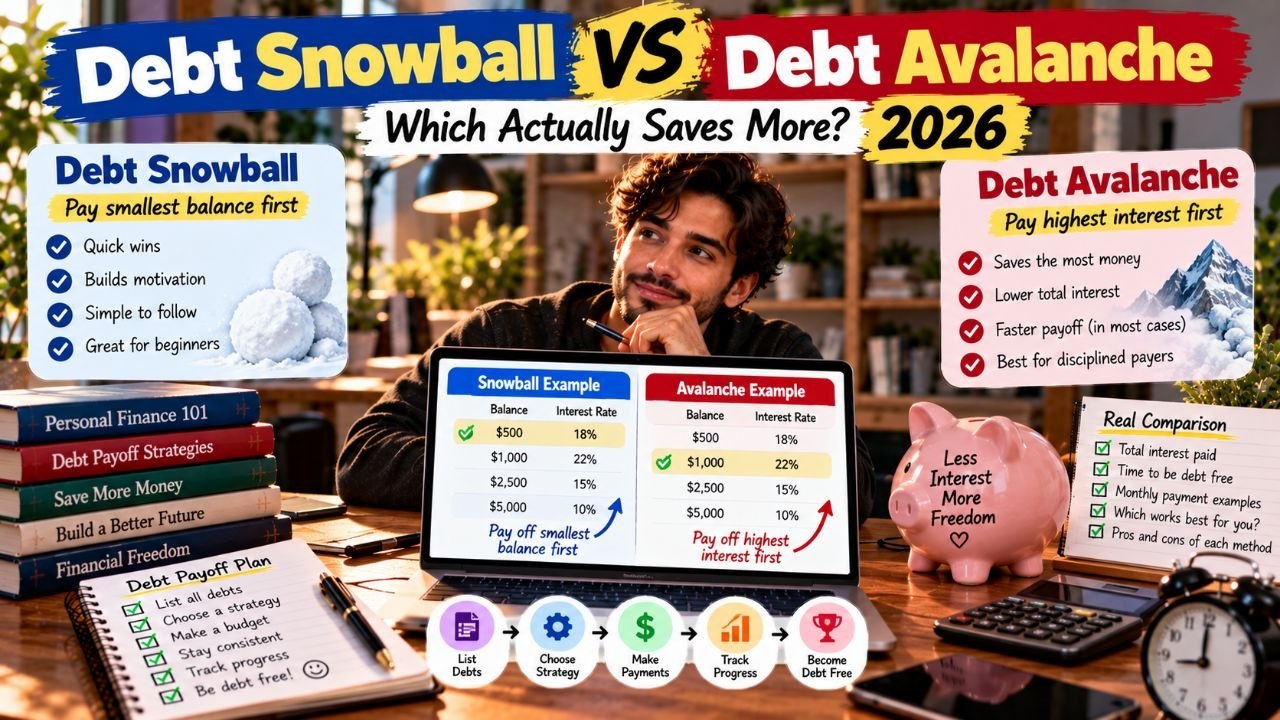
Short answer: the avalanche method (highest interest rate first) costs less in total interest, while the snowball method (smallest balance first) gets you a fast early win that keeps you going. In our worked example below the gap was only $110.65 over roughly three years — real, but small. The method you actually finish beats the method that looks better on paper.
What the two methods actually do
Both methods ask the same thing of you: pay the minimum on every debt, then throw every spare dollar at one target debt until it is gone. The only difference is which debt you target first.
Debt snowball
Attack the smallest balance first, regardless of interest rate. When it is cleared, roll its payment into the next smallest balance. The appeal is psychological: you retire an entire account quickly, and each closed account adds momentum.
Debt avalanche
Attack the highest interest rate first. Mathematically this is the cheapest route, because you stop the most expensive money from compounding as early as possible. The trade-off is that the first win can take months.
A worked example with real numbers
Assume four debts, all current, with $300 extra per month on top of minimum payments:
- Store card — $600 at 14.99% (minimum $30)
- Credit card — $3,200 at 26.99% (minimum $85)
- Personal loan — $7,500 at 11.49% (minimum $165)
- Car loan — $9,000 at 6.94% (minimum $215)
Running a standard monthly amortisation (interest applied monthly, minimums paid first, then the extra payment):
| Plan | Months to debt-free | Total interest paid |
|---|---|---|
| Minimum payments only | 79 | $7,504.56 |
| Snowball + $300/month | 35 | $2,903.33 |
| Avalanche + $300/month | 35 | $2,792.68 |
Two things stand out. First, the extra $300 a month is worth far more than the choice of method: it removes roughly $4,601 of interest and about 44 months compared with minimums alone. Second, avalanche beats snowball by $110.65 — about 3.8% less interest — and finishes in the same 35 months.
That is the honest trade: avalanche is cheaper, but only marginally, and only if you stay consistent.
Why the difference is often small
When your highest-rate debt is also reasonably small — as the credit card above — both methods target it early anyway. The gap widens when your biggest balance carries the highest rate and can sit untouched for a year or more under a snowball. If your debts look like that, avalanche saves meaningfully more.
Which method do people actually finish?
Behaviour is the variable that matters most. Snowball creates visible progress early, which helps when motivation is the bottleneck; avalanche rewards patience and consistency. If you have quit a payoff plan before, the snowball is usually the smarter choice even though the maths is slightly worse. If you are steady and want the lowest cost, take avalanche.
The hybrid that most people should use
- Clear any debt under a few hundred dollars first — it is a quick psychological win and removes a payment.
- Switch to avalanche order for everything else (highest APR next).
- Keep the total payment constant. When one debt closes, that payment rolls forward; never let it drift into normal spending.
Four mistakes that quietly cost more than either method
- Only paying minimums. In the example that turned a roughly three-year plan into a six-and-a-half year plan.
- New charges on cards you are paying down. New spending resets progress and usually carries the same high rate.
- Missing a payment. Late payments can mean penalty APRs and a dent in your score — see our guide to what each credit score range actually gets you.
- Paying for debt relief you can get free. Legitimate non-profit counselling exists; the FTC has a plain-language warning about debt relief scams.
Where to keep the money while you work
Keep a small buffer so an emergency does not become new card debt. A high-rate savings account is fine for that buffer — compare current yields in our high-yield savings rate roundup. Then track the payoff itself; a free tracker is enough, and our comparison of free budgeting apps covers the ones that handle debt goals well. Most planners recommend a $1,000 starter emergency fund before attacking debt — here’s the full 2026 emergency fund guide.
If income is the real constraint rather than strategy, raising take-home pay changes the maths more than any ordering choice. Our guides to making money online and survey sites vs cashback apps cover realistic side income that can be thrown at the smallest balance.
When to get help instead
If minimums are already unaffordable, ordering tricks will not fix it. Non-profit credit counselling and hardship programmes can restructure payments; the CFPB explains debt collection and your options. Talk to lenders before you fall behind, not after.
How to calculate your own payoff date in five minutes
You do not need software to compare the two orders. Write down each debt with four numbers: balance, interest rate, minimum payment, and the extra amount you can add each month. Then:
- Add the minimums to get your baseline monthly commitment.
- Add the extra you can sustain. Be conservative — a number you can keep for three years beats a heroic number you abandon in two months.
- Order the list twice: once by balance (snowball), once by rate (avalanche).
- Simulate month by month: apply monthly interest (rate ÷ 12 × balance), pay minimums first, then send everything left to the target debt.
- Repeat until the balances hit zero and note the month when the list empties and how much interest you paid.
A spreadsheet is enough, and any free budgeting tool that supports debt goals works too. The point is not precision to the cent — it is seeing that the extra payment reduces the timeline more than the ordering does.
Snowball vs avalanche with student loans
Student loans change the picture slightly, because many borrowers hold several loans at different rates, sometimes with income-driven repayment running alongside. Two practical notes:
- Stay current on required payments first. Missing a required payment to chase a payoff strategy is a bad trade.
- Target the highest-rate loan when extra money is available. On a stack of federal loans with similar rates, the ordering gap is small — consistency matters more.
Private refinancing can lower the rate, but it usually removes federal protections. Treat it as a separate decision with its own trade-offs, not as a payoff method.
What about balance transfers and consolidation?
Both can help, and both can backfire:
- 0% balance transfer: useful if you clear the balance before the promotional period ends and account for the transfer fee (commonly a few percent of the amount moved). If you cannot clear it in time, the standard rate returns — often higher than before.
- Debt consolidation loan: can reduce the rate and simplify one payment into many, but only if you stop adding new balances. Turning unsecured card debt into a loan secured by an asset is a bigger risk, not a smaller one.
How payoff order affects utilisation and credit
Payoff order barely touches payment history, which is the largest scoring factor, but it can move credit utilisation. Clearing a card you leave open lowers the balance on that account; closing an account removes its limit from the calculation. In practice: pay the balance down, keep long-standing accounts open where practical, and let the score follow the lower balances.
Your first 30 days
- List every debt with balance, rate, minimum and due date.
- Pick the order: smallest balance if you need momentum, highest rate if you want the cheapest path.
- Set one fixed extra payment — automate it on payday.
- Build a $500–$1,000 buffer so surprises do not go back on a card.
- Review at 30 days: if the plan already feels fragile, lower the extra amount rather than quitting.
FAQ
Is the debt snowball or avalanche better in 2026?
Avalanche costs less in total interest. Snowball produces faster wins that help people stay consistent. The difference in our example was $110.65 over three years.
Does the snowball method hurt my credit score?
Neither method hurts by itself — both reduce balances. Payment history and credit utilisation matter more than payoff order.
Should I pay off debt or invest first?
Compare the interest rate on the debt with a realistic after-tax return. Clearing a 25% card is hard to beat; keeping a low-rate loan while investing can make sense.
How much extra per month makes a difference?
In the example, an extra $300 per month cut the timeline from 79 months to 35 months. Even $50–$100 extra shortens the plan measurably.
Can I switch methods halfway?
Yes. Many people snowball until one or two accounts are cleared, then switch to avalanche order. Keep the total monthly payment the same.
What if my highest-rate debt is also my largest?
That is where avalanche saves the most. If the timeline feels discouraging, clear one small balance first, then switch.
The bottom line
Pay more than the minimum, keep the total payment fixed, and pick the order you will stick with. Avalanche is cheaper by a modest margin; snowball is easier to finish. In 2026, with card rates still high, the priority is simply starting — this week, not next month.