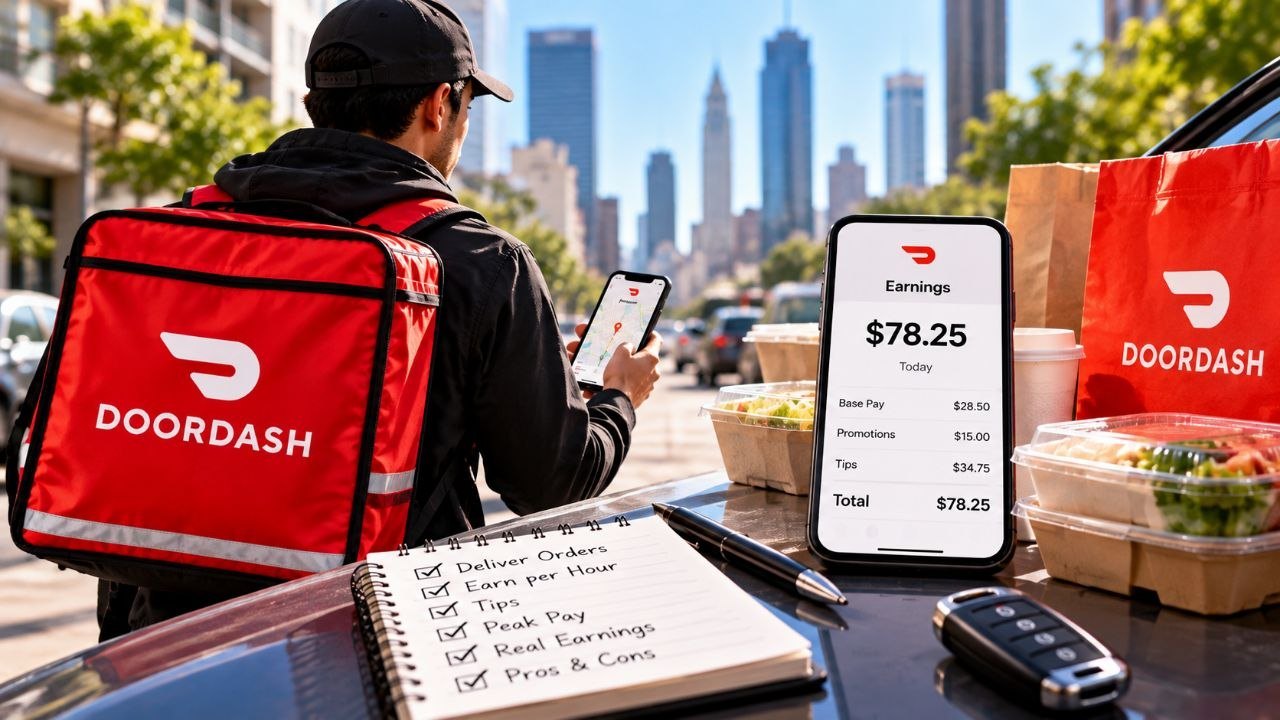
How much does DoorDash pay in 2026? Most DoorDash drivers earn roughly $15–$20 per hour including tips before expenses, with part-time dashers pulling in $150–$400 per week and dedicated full-time drivers $600–$900+ per week in busy markets. Your actual rate depends on your city, when you dash, and how you work the app.
There is no single salary — DoorDash pays per delivery, and every market is different. That vagueness is exactly why so many people ask the same question. In this guide, you’ll get:
- The exact DoorDash pay formula: base pay + tips + promos
- Real driver earnings data per hour, week, and month (with sources)
- How much DoorDash pays in your type of city — big metro vs. suburb vs. rural
- Hidden costs and taxes that cut into your real take-home pay
- Whether DoorDash is worth it in 2026, plus mistakes that cost new drivers money
DoorDash Pay Structure: How Drivers Get Paid
Every DoorDash delivery pays three separate parts. Understanding the formula is the fastest way to judge any offer before you accept it.
1. Base Pay: $2 to $10+ Per Order
DoorDash’s own pay documentation states that base pay ranges from
$2 to $10+ per order, calculated from the estimated time, distance, and “desirability” of the delivery. In practice, most standard orders in 2025–2026 pay between $2 and $4 in base pay. Longer drives, heavy orders, and deliveries nobody else wants (late night, bad weather, far suburbs) pay higher base amounts.
2. Tips: You Keep 100%
Tips are the biggest part of most dashers’ income, and DoorDash passes them through in full — the company states clearly that
dashers keep 100% of tips. Customers tip before or after delivery in the app, and cash tips are rare. An $8 delivery with a $2 base pay and a $5 tip is typical of a normal lunch order.
3. Promos, Peak Pay, and Challenges
DoorDash adds extra money during high-demand windows:
peak pay ($1–$4 extra per order during rush),
promos (“earn $3 extra per delivery in this zone”), and
challenges (complete 12 deliveries between 5–9 PM, earn a $40 bonus). A driver who only works peak hours can add $3–$8 per hour on top of normal earnings.
How Much Do DoorDash Drivers Actually Make Per Hour?
Driver-reported earnings from job sites and gig-economy surveys consistently cluster between
$15 and $20 per hour gross (before gas, maintenance, and taxes) for 2024–2025 data, with the most recent 2025 figures trending toward the top of that range as DoorDash raised base pay in several markets.
Independent salary trackers tell the same story:
- Indeed lists average DoorDash delivery driver pay around $16–$18 per hour including tips for typical US markets.
- Driver surveys (Gridwise and dasher community reports) show $18–$25 per hour during peak dinner and weekend windows, and $12–$15 per hour in slow midday hours.
- DoorDash’s own recruiting materials advertise dashers earning “up to $25/hour,” which reflects peak conditions — not the all-day average.
The honest number: a typical dasher working mixed hours lands around
$17–$19 per hour gross. Work only Friday–Sunday dinner rushes and the number climbs to $22–$25. Work Tuesday afternoons and you’ll be closer to $12–$14.
Active Time vs. Dash Time: Read This Carefully
Driver apps count time two ways.
Active time is only the minutes between picking up an order and dropping it off.
Dash time includes waiting between orders, driving to hotspots, and downtime. If you’re online 40 hours but only active for 28, your “per-hour” pay is really 40 hours of your life. Always calculate earnings against total dash time.
How DoorDash Pay Varies by City and State
Geography changes everything. A base-pay-plus-tip structure means dense, high-tipping cities pay far better than rural zones with long drives and few orders:
- Major metros (NYC, Chicago, LA, SF): $20–$28 per hour during peaks, driven by volume and Prop 22-style protections where they exist.
- Mid-size cities (Austin, Charlotte, Phoenix, Denver): $16–$22 per hour is realistic.
- Suburbs and small towns: $12–$18 per hour, with more miles driven per order.
Two special cases matter in 2026.
California guarantees app drivers (under Proposition 22) 120% of the local minimum wage plus roughly $0.35 per active mile when they’re on a delivery — a real safety net most states lack.
New York City similarly enforces minimum pay for delivery workers that works out to roughly $30 per hour of active time. Outside those markets, DoorDash pay is fully market-driven.
| Market type |
Realistic gross hourly |
Typical delivery |
Notes |
| Large metro (LA, NYC, Chicago) |
$18–$28 |
2–4 per hour |
Highest demand, most traffic and parking cost |
| Mid-size city (Austin, Charlotte, Phoenix, Denver) |
$16–$22 |
2–3 per hour |
Best balance of volume and drive time |
| Suburbs |
$14–$19 |
2–3 per hour |
Longer drives per order, lower tips |
| Small towns and rural |
$12–$18 |
1–2 per hour |
Fewer restaurants, more dead miles |
These ranges are gross earnings reported by drivers, before gas, maintenance and taxes. DoorDash publishes no official hourly figure outside of the pay protections in California and New York City.
How Much Can You Make Per Week With DoorDash?
Realistic weekly math, before expenses, looks like this:
- Weekend-only side hustle (10–14 hours): $180–$320 per week — a solid $700–$1,200 per month.
- Evenings + weekends (20–25 hours): $350–$550 per week.
- Full-time (40–50 hours, peak-heavy schedule): $650–$950 per week in a decent market.
The “$1,000 per week” TikTok claims exist, but they require 55–60 hour weeks in a strong market at peak times — treat them as the ceiling, not the average. And remember: those are gross numbers. After vehicle costs and taxes, full-time dashers typically keep
65–75% of what the app shows.
The Hidden Costs That Shrink DoorDash Pay
DoorDash shows you gross earnings. Your bank account sees something smaller. The three silent deductions:
Gas and Maintenance
The IRS standard mileage rate is the closest thing to a real cost estimate for driving, and it changed twice in 2026. Business mileage is
72.5 cents per mile from January 1 to June 30, 2026 and
76 cents per mile from July 1 to December 31, 2026 (IRS
standard mileage rates). A typical dasher drives 80–150 paid miles per shift — at 76 cents a mile that is
$61–$114 of deductible vehicle cost per shift, whether or not the app reimburses you (it does not).
Fast Pay Fees and Repairs
Instant cash-out through Fast Pay costs about $2 per transfer. Tires, oil changes, and the occasional repair are entirely on you. Dashers who skip maintenance budgeting are the ones who “make nothing” — the math was never bad, the car cost was just never counted.
DoorDash Mileage Deduction in 2026 (The Biggest Tax Break)
Every business mile you drive counts as a deductible expense, and 2026 is a good year for it because the IRS raised the rate mid-year:
| Period in 2026 |
Business rate |
Deduction on 10,000 miles |
| January 1 – June 30, 2026 |
72.5 cents/mile |
$7,250 |
| July 1 – December 31, 2026 |
76 cents/mile |
$7,600 |
| Full year (60/40 split, 10,000 miles) |
Blended ≈ 74.4 cents/mile |
≈ $7,440 |
Two ways to claim vehicle costs:
- Standard mileage rate: multiply business miles by the IRS rate. Simple, no receipts for gas or repairs, and usually the better choice for dashers who drive an older, paid-off car.
- Actual expenses: track gas, insurance, repairs, tires, depreciation and registration, then deduct the business-use percentage. This can beat the standard rate in a high-cost year (a big repair, for example) but requires clean records from day one.
You cannot deduct both, and you cannot switch freely — using the standard rate in the first year a vehicle is used for business locks in some restrictions later. Log every mile with an app like Stride or Gridwise, and note that your
commute to your starting zone is not deductible, but miles between deliveries and the trip home at the end of your last delivery generally are.
The mileage deduction flows onto
Schedule C, which lowers both your income tax and your self-employment tax.
DoorDash Taxes in 2026: What You Actually Owe
DoorDash classifies drivers as independent contractors, so taxes are your responsibility. Here is the 2026 picture:
| Tax item |
2026 figure |
What it means for you |
| Self-employment tax rate |
15.3% |
12.4% Social Security + 2.9% Medicare, applied to 92.35% of net profit |
| Social Security wage base |
$184,500 |
Social Security tax stops above this |
| 1099-K reporting threshold |
$20,000 and 200 transactions |
Payment apps report at this level; you owe tax regardless |
| Quarterly estimated taxes |
Apr 15, Jun 15, Sep 15, Jan 15 |
Miss them and the IRS charges penalties and interest |
| QBI deduction |
Up to 20% of qualified business income |
Many dashers qualify — ask a tax pro about it |
A workable rule of thumb: set aside
20–30% of every gross payout in a separate savings account. After the mileage deduction, most part-time dashers land closer to the 20% end; full-time dashers with high net profit should plan on 25–30%. More detail on how that math works is in our full guide to
self-employment tax in 2026.
Deductible costs beyond mileage include your phone plan (business-use share), a phone mount, insulated bags, dashcam, tolls and parking on deliveries, and a portion of your insurance in some cases. Keep every receipt — the Cohan rule lets you estimate some expenses, but documentation wins audits.
DoorDash vs Uber Eats vs Instacart in 2026
| App |
Typical gross hourly |
Best for |
Watch out for |
| DoorDash |
$15–$22 |
Meal-time volume, peak pay stacking |
Long-distance, low-tip offers |
| Uber Eats |
$14–$21 |
Dense downtown restaurant clusters |
Lower base pay, tip baiting reports |
| Instacart |
$15–$25 |
Large-batch grocery orders, big tips |
Heavy lifting, long shop times, order-grabbing |
If payout timing matters more to you than peak pay, our breakdown of
same-day pay on Instacart, Amazon Flex and Shipt covers deposit schedules, instant cashout fees and why tips often land in a later cycle. For the fastes payouts, see our guide to the
gig apps that pay same day.
These are driver-reported ranges, not guarantees — the honest answer is that most multi-app drivers earn more per hour than single-app drivers because they stop waiting between offers. The trade-off is a busier phone and more admin. For the rideshare side of the comparison, see
how much Uber pays drivers in 2026, where gross pay averages $23.88 per active hour but net lands near $15–$18 after expenses.
Is DoorDash Worth It in 2026?
DoorDash is worth it when you treat it like a business: work peak hours, track mileage, and live in a busy market. It’s a poor fit if you need guaranteed income, drive an inefficient car, or dash in a slow zone during off-peak hours.
Pros: start within days, no interview, flexible schedule, keep 100% of tips, daily cash-out available, and steady demand (food delivery is not going away).
Cons: no hourly guarantee (outside CA/NYC), vehicle wear, self-employment taxes, and income that swings wildly by season and market.
For most people, DoorDash works best as a flexible side hustle stacked on top of other income — the same strategy we outline in our guide to
realistic ways to make money online in 2026. And once the earnings start landing, park what you don’t need in a
CD ladder so your delivery money grows while you sleep.
How to Make More Money With DoorDash
Experienced dashers don’t earn more by driving faster — they earn more by accepting smarter. These seven habits separate $15/hour dashers from $22/hour dashers:
- Work peak hours only: 11 AM–1 PM and 5–9 PM Thursday through Sunday deliver 70% of the week’s best offers.
- Set a minimum dollar-per-mile rule: decline anything under $1 per mile (most pros use $1.50–$2/mile in busy zones).
- Learn your zone’s restaurant clusters: short pickups near dense restaurants mean more deliveries per hour.
- Stack promotions: schedule dashes ahead to unlock peak pay and chase challenges only when they overlap naturally.
- Track every mile: a mileage app (Stride or Gridwise) turns your gas costs into a tax deduction that often saves $1,500–$3,000 a year.
- Multi-app carefully: running Uber Eats alongside DoorDash fills dead time — but only accept one order at a time to protect ratings.
- Protect your acceptance rate strategically: stay above 50% to keep scheduling freedom, but never accept a money-losing order out of fear.
Common Mistakes New Dashers Make
Three errors explain most “DoorDash doesn’t pay” complaints. First, dashing at 2 PM on a Tuesday and judging the whole platform by it — off-peak hours pay badly everywhere. Second, ignoring miles: driving 20 minutes to a $9 order that’s 12 miles away is a $3 order after costs. Third, forgetting taxes entirely and getting hit with a surprise 1099 bill in April. Avoid those three and you’re already ahead of most new drivers.
Frequently Asked Questions About DoorDash Pay
How much does DoorDash pay per hour in 2026?
Most US dashers earn $15–$20 per hour gross including tips, before vehicle costs and taxes. Peak-hour drivers in busy metros often reach $22–$28 per hour; slow off-peak shifts can drop to $12–$15. California and New York City have minimum-pay protections that raise the floor.
Do DoorDash drivers get paid hourly?
No. DoorDash pays per completed delivery through a base pay of $2–$10+ plus 100% of tips, with extra peak pay and promos during busy times. There is no hourly wage in most states — only per-order earnings.
How much does DoorDash pay per delivery?
A typical order pays $5–$10 total (base pay of $2–$4 plus a tip). Larger, longer, or high-demand deliveries pay more, sometimes $12–$20 for stacked or long-distance orders during peak hours.
Do DoorDash drivers keep 100% of their tips?
Yes. DoorDash passes tips through in full, and the company states this in its official pay policy. Tips from the app are added to your weekly payout or available instantly through Fast Pay.
How much can a DoorDash driver make in a week?
A weekend-only dasher typically makes $180–$320 per week, while a full-time dasher working 40–50 peak-heavy hours earns $650–$950 per week gross in a decent market. Net pay after gas and taxes is roughly 65–75% of that.
Is DoorDash worth it in 2026?
It’s worth it as a flexible side hustle if you work peak hours, track mileage for taxes, and dash in a busy market. It’s less attractive as full-time income in slow areas or with an inefficient vehicle, since there’s no guaranteed hourly wage outside California and New York City.
How often does DoorDash pay drivers?
DoorDash pays weekly by direct deposit, usually on Monday or Tuesday for the previous week. Drivers can also cash out anytime with Fast Pay for a fee of about $2 per transfer, or use the Crimson debit card for instant payouts.
Can I deduct my DoorDash mileage in 2026?
Yes. Business miles are deductible at 72.5 cents per mile from January 1 to June 30, 2026 and 76 cents per mile from July 1 to December 31, 2026, claimed on Schedule C either through the standard mileage rate or actual expenses.
How much should I set aside for DoorDash taxes?
Set aside 20–30% of gross payouts. Budget 15.3% for self-employment tax plus federal and state income tax, and pay quarterly estimated taxes in April, June, September and January.
Is DoorDash or Uber Eats better paying in 2026?
Both pay roughly $14–$22 per hour gross depending on market. DoorDash tends to pay more in suburbs and smaller cities, while Uber Eats can win in dense downtown areas. Most drivers run both apps.
Bottom Line: DoorDash Pay in 2026
So, how much does DoorDash pay? Expect
$15–$20 per hour gross as a realistic all-around number, more during peaks in good markets, less off-peak in slow ones — and always less after you subtract gas, wear, and the 15.3% self-employment tax. DoorDash is a legitimate, flexible earner, not a get-rich platform. Track your miles, work smart hours, treat it like a business, and it can reliably fund your savings, side goals, or a
bigger money plan.
Related reading
Related reading
Updated November 2026: see our newer, full DoorDash driver pay breakdown with worked take-home examples.
Related guides
If you are comparing earnings across platforms, these recent breakdowns use the same 2026 pay data and after-expense math: