
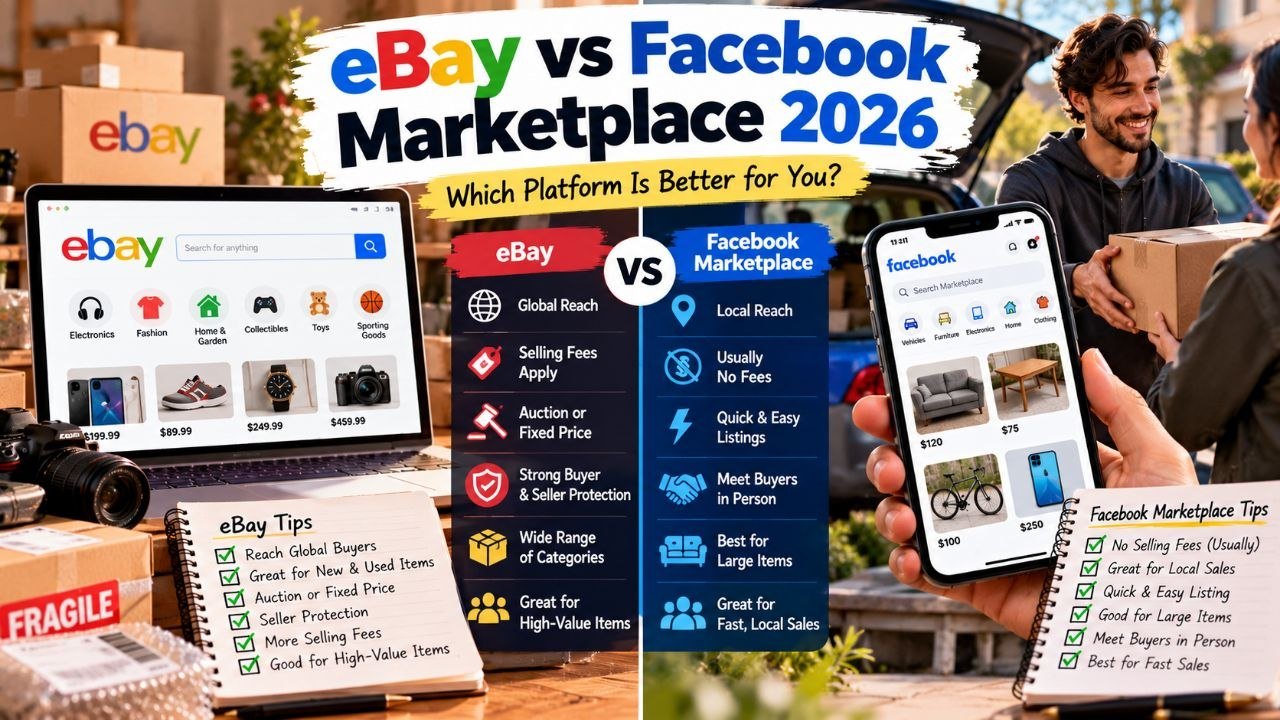
eBay vs Facebook Marketplace 2026: What Resellers Actually Keep
The same jacket can pay you $28 on eBay and $38 on Facebook Marketplace, without you changing the price. That gap is not luck — it is fees, shipping and how each platform moves your money. This guide compares the two using eBay’s published 2026 fee schedule and the IRS rules that apply to online sales, then runs the real math on three flips.
The short answer
- eBay = national and international buyers, a documented fee on nearly every dollar the buyer pays (including shipping), and payouts that arrive after the sale is confirmed.
- Facebook Marketplace = local buyers, cash in hand for pickup sales, no platform fee on an in-person transaction, and a buyer pool limited to your area.
- Rule of thumb: if the item is light, rare and ships cheaply, eBay usually wins. If it is heavy, bulky or cheap, local pickup usually wins.
What eBay actually charges in 2026
eBay charges one final value fee when an item sells, and that fee now includes payment processing — there is no separate PayPal-style cut. For most categories in 2026 the structure is:
- 13.6% of the total amount of the sale, calculated per item, on the first $7,500
- 2.35% on the portion of the sale above $7,500
- $0.30 per order as a per-order fee
Some categories differ. Women’s handbags, for example, run 15% up to $2,000 and 9% above that, and bullion is charged at a lower rate. Always check the category table before you price an item.
“Total amount of the sale” includes shipping
This is where most new resellers lose money. eBay calculates its percentage on what the buyer pays, so if you charge $8 shipping on a $60 item, you are paying a fee on $68, not $60. One exception cuts in your favour: if you offer free domestic shipping, eBay does not charge a final value fee on the shipping portion, because the buyer does not pay a separate shipping amount.
When the money actually lands
eBay pays out after the buyer’s payment is confirmed. New accounts, high-value sales and items in some categories can see funds held until delivery is confirmed. The practical consequence: you buy the shipping label out of your own pocket before the payout arrives, so plan on floating $50–$150 of postage in a normal flipping month.
What Facebook Marketplace actually costs
Marketplace has no listing fee and no monthly fee. When you list an item, meet a buyer and take cash or a peer-to-peer transfer, no platform fee is deducted because the money never passes through Meta’s checkout. That is the entire appeal: on a $60 local sale you keep $60.
Two caveats matter:
- Shipped orders are different. If you use Marketplace’s shipping option, the order runs through Meta’s checkout and Meta’s own selling-fee schedule applies. Check Meta’s current Marketplace fee page before enabling shipping on a listing.
- The real cost is time and risk. You will deal with no-shows, lowballers and messages that go nowhere. There is no feedback score, no seller protection for a cash meetup, and no chargeback system — which also means no returns after the buyer walks away.
Worked example 1: a $20 thrift jacket, sold for $60
eBay route: you list at $60 with $8 shipping, so the buyer pays $68.
- Final value fee: 13.6% × $68 = $9.25
- Per-order fee: $0.30
- Shipping label you buy: about $9.00
- Box, tape, polymailer: about $1.00
- Cost of the jacket: $20.00
Net: $68.00 − $9.55 − $9.00 − $1.00 − $20.00 = $28.45.
Facebook Marketplace route: same jacket, listed at $60, buyer picks it up.
- Platform fees: $0.00
- Fuel for the meetup: about $2.00
- Cost of the jacket: $20.00
Net: $60.00 − $20.00 − $2.00 = $38.00.
On this flip, local pickup kept $9.55 more. That is the fee stack plus shipping and packaging that a pickup sale simply never incurs.
Worked example 2: a rare sneaker, sold for $200
Here the platform advantage flips. On Facebook you might get $150 locally because only a handful of people in your city collect that model. On eBay the national market pays $200.
- eBay: buyer pays $200 + $15 shipping = $215
- Final value fee: 13.6% × $215 = $29.24, plus $0.30 = $29.54
- Label $14.00, packaging $2.00, cost basis $80.00
- Net: $215 − $29.54 − $14 − $2 − $80 = $89.46
Compare that with a $150 local cash sale: $150 − $80 − $2 fuel = $68. eBay still returned more than $21 extra after its fees, because the national buyer pool set a higher price than your zip code could.
Worked example 3: a solid-wood dresser, sold for $120
Nobody ships a dresser profitably. If you tried on eBay, freight-style shipping on a heavy item can run $85 or more, which wipes out the sale before fees are even counted. Locally, the same dresser sells in a weekend:
- $120 cash on pickup, $0 in fees, about $3 in fuel
- Net: $117 against a $40 cost basis = $77 profit
This is the clearest split in reselling: weight decides the platform.
The tax part most flippers miss
Under current IRS rules, a payment app or online marketplace must send you a Form 1099-K when the payments you receive for goods or services total more than $20,000 across more than 200 transactions in a year. The IRS also notes you can receive a 1099-K even when you are below those thresholds, and that the form is an information return — it is not a tax bill by itself.
What matters for resellers:
- A cash pickup sale leaves no platform paper trail, but the income is still reportable if you are running a flipping business.
- Personal items you sell at a loss generally are not taxable income, but you need the receipt or a reasonable record of your cost basis to show it.
- Deductions are where the margin lives: cost of goods, shipping, packaging, mileage to thrift stores and marketplaces, and home storage space. See our side hustle tax deductions guide for the full list, and self-employment tax for the 15.3% you owe on net profit.
How to run both platforms without doing the work twice
- Photograph once, list twice. Take eight clean photos on a white background, then reuse the same set on both platforms.
- Price for the platform. On eBay, add the 13.6% fee plus shipping to your cost before setting the Buy It Now number. On Marketplace, price for a fast local sale.
- Screen by weight. Under roughly five pounds and worth $50 or more → eBay. Heavy, bulky or under $50 → local pickup.
- Keep a flip log. Item, cost basis, listing price, fees, shipping, date sold. This single spreadsheet makes tax season trivial and shows you which categories actually pay.
- Meet safely. Public places, daylight, cash or an instant transfer confirmed in front of you.
- Refresh stale listings. On Marketplace, relisting every week or two often beats waiting on one old listing.
- Reinvest the first $500. The cash you keep from your first flips should fund better inventory, not a new phone.
If you are still deciding where reselling fits next to gig work, our breakdown of gig apps that pay the same day is a useful reality check on how fast each option converts your time into cash. Reselling has the same core rule as marketplace selling in general — the platform that reaches the buyer with the deepest pockets wins, as long as shipping does not eat the difference. Our Etsy take-home breakdown shows the same fee math applied to handmade goods, and Upwork’s fee structure shows how services compare. Reselling is one branch of a wider picture — our gig and creator income hub compares platform pay across gig apps, marketplaces and creator payouts.
FAQ
Does Facebook Marketplace charge sellers a fee?
Not for an in-person pickup sale paid in cash or by direct transfer. Shipped orders placed through Marketplace use Meta’s checkout, and Meta’s own selling-fee schedule applies to those, so check Meta’s Marketplace fee page before enabling shipping.
Is eBay or Facebook Marketplace better for beginners?
Start on Facebook Marketplace if you are flipping furniture, appliances or anything heavy, because there are no fees and no shipping to learn. Move to eBay once you are sourcing small, shippable items worth $50 or more.
Will I get a 1099-K from eBay or Facebook Marketplace?
Only if your payments for goods and services through that platform exceed $20,000 in more than 200 transactions in the year, under current IRS thresholds. You can still receive one below that level, and it is an information return rather than a bill.
Which platform gets higher prices?
eBay, for anything collectible or rare, because national and international buyers bid against each other. Facebook Marketplace gets higher prices only when the item is too heavy or too bulky to ship.
How do I avoid losing money on eBay shipping?
Either bake shipping into the item price and offer free domestic shipping — eBay does not charge its final value fee on shipping in that case — or weigh and measure every item before you set the shipping charge.
Sources
This article is educational information, not personalized tax or financial advice. Fee schedules and IRS thresholds can change; confirm current figures with eBay, Meta and a qualified tax professional before making decisions.
Selling fashion as well? Compare Poshmark vs Mercari fees in 2026 to see which app leaves you more per sale.
Once those resale payouts land, our guide to high-yield savings rates for 2026 covers where to park the cash while you restock.