
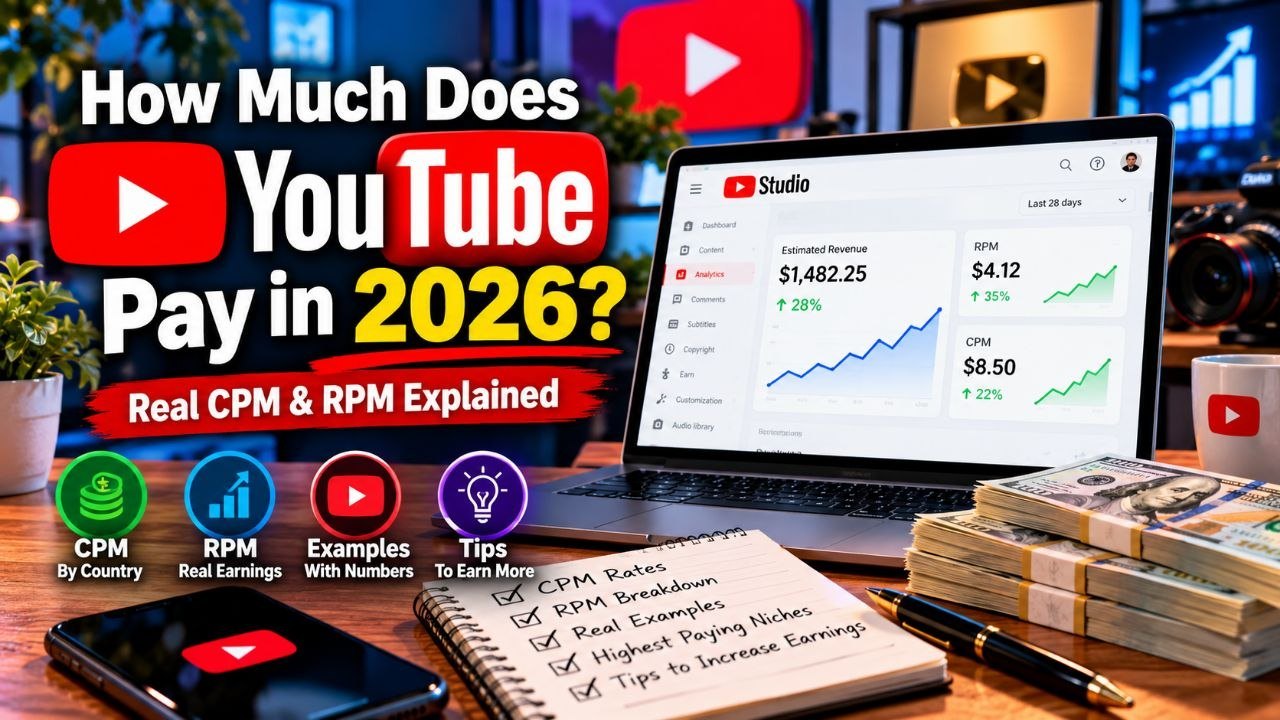
Short answer: most monetized YouTubers in 2026 earn between $1 and $12 per 1,000 views (their RPM) from ads alone — while channels in high-paying niches like finance and tech regularly see $15 to $40 CPM, and gaming or entertainment channels often get only $1 to $6. In other words, “how much does YouTube pay” has no single number: it depends on your niche, where your audience lives, and how long people watch. This guide breaks down real per-1,000-view rates, CPM by niche, Shorts pay, YouTube Partner Program requirements, and what actual creators earn in 2026.
In this guide you will find:
- YouTube ka per-1,000-views pay breakdown (2026 figures)
- CPM vs RPM: the difference and why it matters
- Niche-wise CPM table (finance, tech, gaming, lifestyle and more)
- Shorts earnings, YPP requirements and payout rules
- Real creator earning examples + 7 factors that raise or lower your rate
How Much Does YouTube Pay Per 1,000 Views in 2026?
The fastest honest answer: expect roughly $0.50 to $6 per 1,000 monetized views for an average channel, with standout niches reaching $10–$30. YouTube pays creators about 55% of the net ad revenue their videos generate (for standard long-form ads), so your earnings are tied to what advertisers bid — not to view counts alone.
| Channel Type | Typical RPM (per 1,000 views) | Typical CPM (advertiser rate) |
|---|---|---|
| Finance / investing | $8 – $30 | $15 – $40 |
| Tech / software / AI | $6 – $18 | $10 – $25 |
| Education / how-to | $4 – $15 | $8 – $20 |
| Health & fitness | $3 – $12 | $6 – $18 |
| Lifestyle / vlogs | $1.50 – $8 | $3 – $10 |
| Gaming | $0.80 – $5 | $1.50 – $8 |
| Entertainment / memes | $0.50 – $4 | $1 – $6 |
These ranges are based on public creator reports and industry trackers for 2025-2026 — such as the Influencer Marketing Hub YouTube money calculator and Social Blade. Your actual number can land above or below this table, which is why niche selection is the single biggest pay driver. If you are exploring earning angles, our guide to realistic ways to make money online also covers YouTube-style side hustles.
CPM vs RPM: The Two Numbers That Decide Your YouTube Pay
People mix these up constantly, and it changes how you read every “how much does YouTube pay” stat online:
- CPM (cost per mille) = what advertisers pay per 1,000 ad impressions. This is not your income — it is YouTube’s gross revenue.
- RPM (revenue per mille) = what you actually earn per 1,000 video views, after YouTube’s cut, after ads on non-monetized views are excluded. RPM is the number that matters.
Example: if an advertiser pays a $20 CPM, YouTube passes roughly 55% ($11) to the creator — and if ads only run on 60% of views, the effective RPM works out to about $6.60. That is why a high CPM plus a high ad-impression rate equals higher pay.
YouTube CPM by Niche in 2026: Highest-Paying Categories
Advertisers pay premium rates where viewers have money and buying intent. That is why finance, business and tech niches consistently pay 3–5x more than gaming or entertainment.
Finance & Investing (highest paying)
Personal finance, investing, FIRE and crypto content usually earns a CPM of $15–$40. Banks, brokers and fintech apps bid aggressively for this audience. This is the same niche where smart-money sites build content around CD ladder and similar passive income strategies.
Tech, AI & Software
AI tools, SaaS reviews and coding tutorials typically earn $10–$25 CPM. In 2026 both viewer demand and advertiser spend for AI-related content are high, making it one of the most profitable content categories right now.
Education & How-To
Online courses, exam prep and skill tutorials generally earn $8–$20 CPM. Google treats education content as E-E-A-T friendly, so genuine tutorials keep earning consistent views over the long term.
Gaming & Entertainment (high volume, low pay)
Gaming CPM is often just $1.50–$8 — high volume but low advertiser rates. Entertainment and meme content runs lower still ($1–$6). In these niches creators earn mainly from sponsorships and memberships rather than ads.
What About YouTube Shorts Pay in 2026?
The Shorts pay structure changed in 2025: Shorts now run on a 45% ad-revenue-share model (the earlier creator pool ended), a change YouTube’s official creator blog announced. In practice, most US creators report roughly $0.05 to $0.35 per 1,000 Shorts views, a fraction of long-form earnings. Shorts are best for discovery (subscribers and funnel), while long-form (8+ minute) videos are far more profitable for direct ad income. A solid strategy: use Shorts to build an audience, then move those viewers toward long-form content or other gig-style income sources that pay predictably.
Real Examples: How Much YouTubers Actually Earn
Numbers can feel abstract, so here are three realistic scenarios (2026 rates, US audience, monetized views):
- Beginner finance channel (25K subs): 300,000 monetized views/month at $12 RPM → ~$3,600/month from ads alone.
- Mid-size tech channel (150K subs): 1.5M views/month at $8 RPM → ~$12,000/month ads + usually 2–3x more from sponsorships.
- Gaming channel (500K subs): 4M views/month at a $2 RPM → ~$8,000/month from ads — high volume, low rate, so this channel depends more on memberships and donations.
At the top tier, Forbes’ annual creator lists put MrBeast and similar top earners at $80–100 million+ per year — but most of that comes from brand deals, merch and ventures rather than AdSense alone. A realistic expectation for beginners: $100–$1,000 per month from ads in the first year or two is a respectable result.
7 Factors That Decide Your YouTube Pay Rate
- Niche: finance/tech > education > lifestyle > gaming/entertainment (see the table above).
- Audience location: US, UK, Canada, Australia viewers pay 5–10x more CPM than viewers in India, Pakistan or the Philippines.
- Video length: 8+ minute videos allow more mid-roll ads = more revenue per view.
- Watch time & retention: more watch time = more ad impressions = higher RPM.
- Seasonality: in Q4 (Oct–Dec) advertiser budgets spike — holiday-season CPMs can rise 20–40%.
- Ad formats used: skippable + non-skippable + overlay combinations improve RPM.
- Ad blocker rate: tech audiences use more ad blockers, which lowers effective RPM.
YouTube Partner Program Requirements in 2026 (Get Paid Checklist)
You are not paid until you are approved for the YouTube Partner Program (YPP). The current requirements are published on YouTube Help’s official YPP page:
- Full ad monetization: 1,000 subscribers + 4,000 valid public watch hours (12 months) or 1,000 subscribers + 10 million public Shorts views (90 days).
- Fan-funding tier (500 subs): 500 subscribers + 3 public uploads in 90 days + (3,000 watch hours or 3M Shorts views) → memberships, Super Chat and Super Thanks become available (but not ads).
- Policy compliance: no reused content, AdSense account linked, 2-step verification on, channel in a supported country (US ✅).
Even after approval, YouTube reviews your first 90 days, so consistent original content is the safe path.
How Does YouTube Pay You? Threshold & Payout Details
YouTube pays creators through Google AdSense:
- Payment threshold: $100 (no payout until your balance reaches $100).
- Payout schedule: around the 21st of each month, once you have crossed the threshold.
- Payout methods: in the US, bank transfer (wire/ACH) and checks are supported; tax information is submitted through the W-9 form in AdSense.
- Holding period: recent earnings stay “pending” for a few weeks before they move into your payable balance — that is normal, not a problem.
Beyond Ads: Where YouTubers Really Make the Big Money
Most full-time creators earn two to three times more from sponsorships, affiliate marketing, merch and digital products than from AdSense. A finance YouTuber making $3,000/month from AdSense is often also earning $8,000–$15,000 from brand deals and affiliate income. Treat AdSense as a “base salary” — once your audience is built, diversified income is the real game.
FAQ: How Much Does YouTube Pay
How much does YouTube pay per 1,000 views in 2026?
Average channels earn $0.50–$6 RPM (per 1,000 monetized views), while finance, tech, aur education niches often reach $8–$30. Gaming aur entertainment typically $0.50–$5.
How much does YouTube pay per view?
On a per-view basis that works out to $0.0005 to $0.03 — roughly $0.50–$30 per 1,000 views, depending on the niche and the audience’s country. A “view” does not earn money without ads; only monetized views count.
How much does YouTube pay for 1 million views?
In the US finance niche, 1M monetized views can pay $10,000–$30,000; an average mixed-audience channel typically earns $1,000–$6,000; gaming and entertainment $500–$5,000.
How much does YouTube pay for 1,000 Shorts views?
Most creators report $0.05–$0.35 per 1,000 Shorts views — Shorts are best for discovery, but direct ad income is a fraction of long-form.
How many subscribers do you need to get paid on YouTube?
1,000 subscribers + 4,000 watch hours (or 10M Shorts views) unlock full AdSense; 500 subscribers + 3,000 hours (or 3M Shorts views) qualify you for fan-funding features (memberships, Super Chat).
Do YouTubers get paid monthly?
Yes — AdSense earnings are paid around the 21st of each month, once your balance has crossed the $100 threshold.
What is the highest-paying YouTube niche in 2026?
Finance and investing pay the highest CPM ($15–$40), followed by tech/AI and education. These niches have high-intent, high-income audiences that advertisers bid a premium to reach.
Bottom Line: YouTube Pay in 2026
YouTube remains a legitimate income platform in 2026, but expectations need to stay realistic: per-1,000-view pay is niche-driven, and beginners will not earn much in the first year. A smart approach is a high-CPM niche (finance, tech, education) plus US/UK audience targeting and 8+ minute videos, treating ads as only one income pillar. If you want diversified side income, make YouTube part of your overall plan — Root Earn publishes more money-making breakdowns like this regularly.
Disclaimer: this article is based on estimated ranges and public creator reports; actual earnings vary. Income figures are educational, not financial advice.
Related reading: if you want the per-view math instead of annual earnings, see how much YouTube pays per 1,000 views in 2026. Comparing platforms? Our breakdown of what TikTok creators actually earn and Fiverr freelancer earnings shows where the money really is.
Sources: IRS — Self-employment tax.