
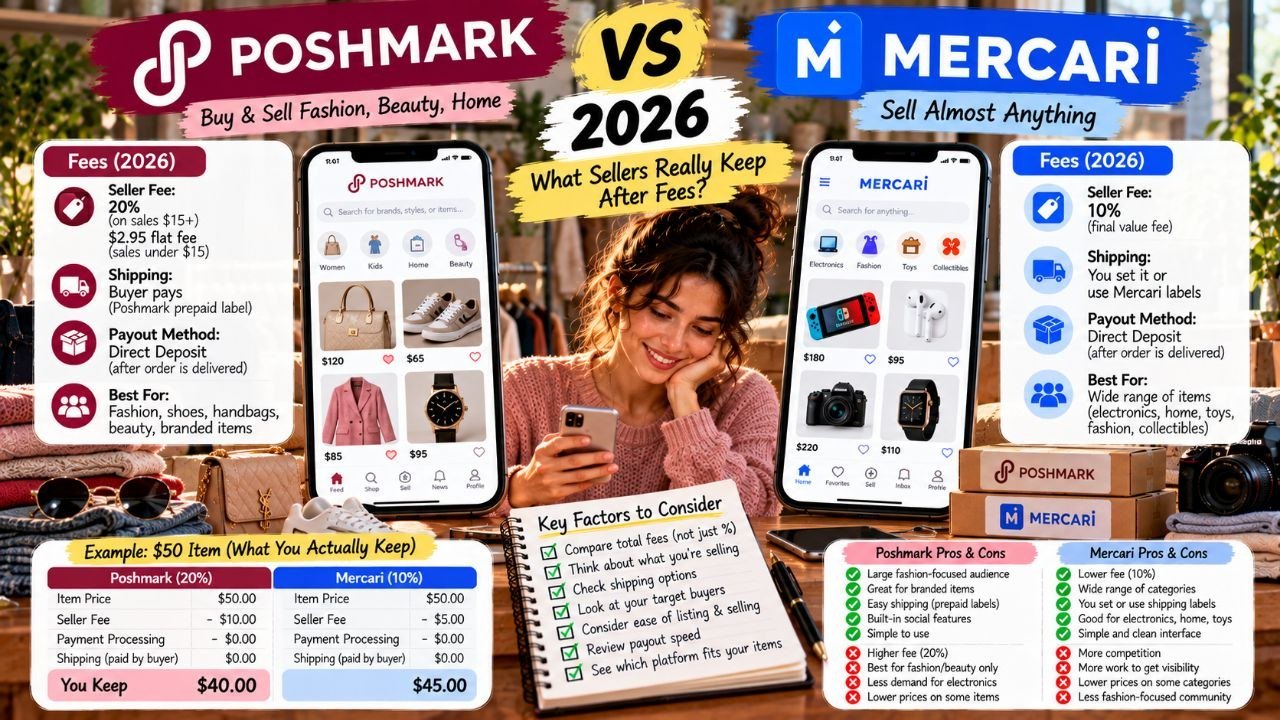
Short answer: in 2026 Poshmark takes a flat $2.95 on any sale under $15 and a 20% commission on sales of $15 or more. Mercari charges a 10% selling fee plus a 3.6% Buyer Protection fee that the buyer pays on top. If fees were the only thing that mattered, Mercari would keep you more money at every single price point. What actually decides it is where your buyers already shop, and who pays for shipping.
This comparison runs the real numbers from both platforms’ published fee pages, then walks through what you actually deposit on $12, $20, $50 and $100 sales, including the fee details most sellers only notice after their first payout. No guesswork, no “up to 90% off” nonsense.
Poshmark vs Mercari fees in 2026 at a glance
| Platform | Seller fee (2026) | Fee on a $50 item | Shipping |
|---|---|---|---|
| Poshmark | $2.95 flat under $15; 20% of the sale price at $15 and up | $10.00 | Buyer pays a Poshmark shipping label at checkout |
| Mercari | 10% of the item price plus any shipping the buyer pays | $5.00 (item price only) | Buyer pays by default; you can offer free shipping and absorb it |
Both platforms now push the shipping cost to the buyer in the standard flow. The big split is the commission model: Poshmark uses a flat fee on cheap items and a percentage on everything else, while Mercari uses one flat percentage.
What Poshmark actually takes in 2026
Poshmark’s official fee page describes the structure in one sentence: for sales under $15, Poshmark takes a flat $2.95 commission; for sales of $15 or more, you keep 80% of the sale and Poshmark takes 20%. There is no separate payment processing line item on top of that.
The $15 breakpoint is the whole story
That breakpoint creates a cliff. A $14.99 item costs you $2.95 in commission. A $15.00 item costs you $3.00. In that narrow band the flat fee is slightly cheaper, but the advantage disappears immediately above it, because 20% keeps climbing while $2.95 stayed fixed.
The flat fee is brutal on cheap inventory. On a $12 sale, $2.95 is 24.6% of the sale price — more than the 20% rate you would pay on a $50 item. If your closet is full of $8 to $14 accessories, your effective commission is roughly a quarter of every sale.
Shipping stays out of your payout
On Poshmark, the buyer pays for a prepaid Poshmark shipping label at checkout, so shipping normally never touches your balance. Your math stays clean: sale price minus commission equals your payout. The exception is anything you do to sweeten a deal — a price drop, a bundle discount, an offer to likers — because every dollar you cut off the price also cuts your payout, while Poshmark’s percentage simply recalculates on the new, lower number.
Worked example: a $50 sale on Poshmark
A $50 sale at 20% commission means a $10.00 fee and a $40.00 payout. Ship it, and you are done — no fee creep, no processing charge. That simplicity is genuinely Poshmark’s strength. The problem is what the same item earns elsewhere.
What Mercari actually takes in 2026
Mercari’s fee update changed the shape of selling there. Sellers pay a 10% selling fee, buyers pay a 3.6% Buyer Protection fee on the item price plus buyer-paid shipping, and the old separate payment processing fee was removed at the same time. Listing itself is free on both platforms; fees only apply when something sells.
Your 10% is calculated on more than the item price
This is the detail that trips people up. Mercari’s 10% applies to the item price plus the shipping the buyer pays. Sell a $50 item with an $8 shipping charge paid by the buyer, and the fee base is $58, so your fee is $5.80, not $5.00. On heavy or bulky items the shipping line can quietly add a few percent to your effective rate.
The 3.6% buyer fee changes how your listing looks
Because the buyer pays 3.6% at checkout, the number they see is not the price you set. A $50 listing shows up as roughly $51.80 plus shipping. That matters when you price against a competitor selling the identical item: a small price edge on Mercari can vanish at checkout, and buyers do compare final totals.
Cash-out costs
Direct deposit to your bank is free and can be requested once a day, typically landing within about five business days. Instant Pay, which pushes money to an eligible debit card, costs a $3 flat fee per transfer and is capped at $600 per month. The most common mistake is using Instant Pay on a $30 sale — that $3 is a 10% haircut on top of the selling fee.
Real payouts: $12, $20, $50 and $100
| Sale price | Poshmark fee | Poshmark payout | Mercari fee | Mercari payout | Difference |
|---|---|---|---|---|---|
| $12 | $2.95 | $9.05 | $1.20 | $10.80 | +$1.75 on Mercari |
| $20 | $4.00 | $16.00 | $2.00 | $18.00 | +$2.00 on Mercari |
| $50 | $10.00 | $40.00 | $5.00 | $45.00 | +$5.00 on Mercari |
| $100 | $20.00 | $80.00 | $10.00 | $90.00 | +$10.00 on Mercari |
Two notes on that table. First, Mercari’s column shows the fee on the item price only; if the buyer pays $8 in shipping, add roughly $0.80 to the Mercari fee. Second, Poshmark’s commission is calculated on the sale price, so the row is not affected by shipping.
The takeaway is uncomfortable but clear: on identical items sold at identical prices, Poshmark costs you roughly 10% more of the sale than Mercari does. A seller moving $2,000 a month through Poshmark would keep about $200 more per month on Mercari at the same volume.
Where sellers actually lose money
- Cheap items on Poshmark. The $2.95 floor makes anything under $15 expensive to sell. Bundle low-price items into one listing or move them elsewhere.
- Offers to likers. Every discount is subtracted from your payout while the percentage commission recalculates on the smaller sale.
- Instant Pay on small balances. Mercari’s $3 flat transfer fee is trivial on $500 and painful on $30.
- Returns. Both platforms give buyers a short window to open a return. A returned item means shipping time, wasted labor and a relist, and no platform reimburses you for that.
- Taxes. Resale profit is generally taxable income, and platform reselling can create self-employment obligations once it becomes regular activity. Deduct supplies, shipping you absorb, home storage space used exclusively for inventory, and platform fees.
So which platform should you use in 2026?
Pick Poshmark when your inventory is fashion, footwear or accessories, when you want an audience that is already browsing brands, and when you value a per-sale fee you can predict without a calculator. The social sharing and bundling culture also drives sales you would not get on a plain marketplace.
Pick Mercari when your inventory is general merchandise, electronics, tools or collectibles, when your average sale price is above $15, and when keeping a few extra percent per sale is the difference between a hobby and a business.
Run both if you have the time. Cross-list the same item, adjust the Mercari price for the fee gap, and delist immediately when something sells so you never get stuck owing a sale you cannot fill. That is how full-time resellers hedge against platform fee changes, which have moved twice in the last two years on both sites.
Frequently asked questions
How much does Poshmark take in 2026?
A flat $2.95 commission on sales under $15, and 20% of the sale price on sales of $15 or more. No separate payment processing fee is added on top.
What are Mercari’s seller fees in 2026?
Mercari charges sellers 10% of the item price plus any shipping the buyer pays. Buyers pay an additional 3.6% Buyer Protection fee, and the separate payment processing fee was removed.
Is Poshmark or Mercari better for sellers?
On pure fees, Mercari keeps you more money at every price point in this comparison. Poshmark earns its 20% through fashion-focused buyer demand and a buyer-paid shipping label, so the better platform is the one where your specific inventory sells faster.
Who pays shipping on Poshmark and Mercari?
The buyer pays by default on both. On Poshmark the buyer pays for a Poshmark shipping label, and on Mercari the buyer pays a shipping charge unless you choose to offer free shipping. Remember that on Mercari, the shipping the buyer pays is included in the base your 10% fee is calculated on.
Do I still owe tax on resale profit?
Yes. Profit from reselling is taxable income, and once reselling is regular and profit-driven it can carry self-employment tax obligations too. Keep records of what you paid for inventory and what you spent on fees, shipping and supplies.
Related reading on RootEarn: what each gig and creator platform really pays, eBay vs Facebook Marketplace: what resellers keep, what an Etsy shop really takes home, and 17 legit side hustle write-offs.
Sources: Poshmark fee policy and Mercari fees help center.
Source: IRS — Form 1099-K.