
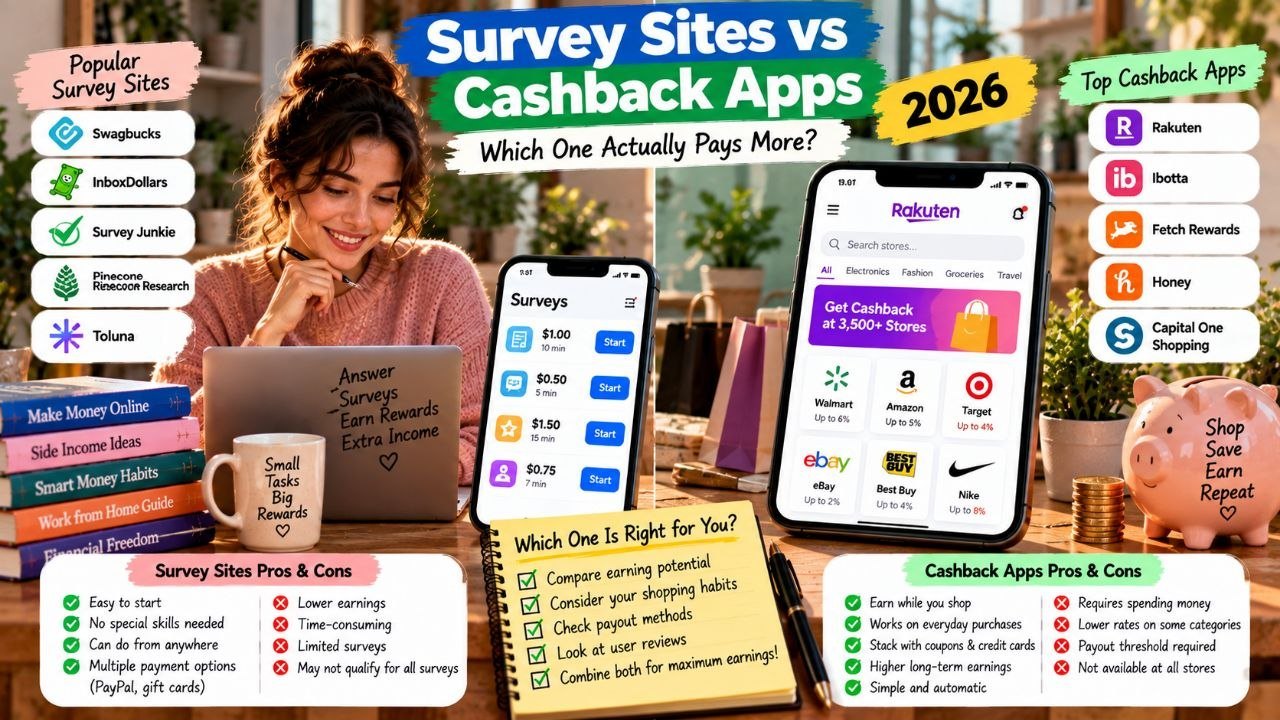
Both promise “free money from your phone,” and both can pay. The difference is what you are selling. A survey site buys your time by the minute. A cashback app returns part of money you were going to spend anyway. That single difference decides which one is worth your evenings in 2026 — and it is why most people quit surveys within a month but keep using cashback apps for years.
The short answer
- Cashback apps pay more per hour in normal use, because you are not trading time for money — you are recovering a slice of spending you already planned.
- Survey sites pay less per hour but cost nothing. You risk time, never cash, and there is no store required.
- The honest survey number is low. A survey that pays $0.60 and takes 12 minutes works out to $3.00 an hour. Fast, well-matched surveys can beat that; long screeners can be far worse.
- Both pay after a threshold, not instantly. Points sitting below the cash-out minimum are worth exactly $0 today.
- Survey and offer rewards are generally taxable income when you receive them; a cashback rebate on a personal purchase is normally treated as a price reduction, not income.
How each one actually pays you
Survey sites: paid per completed interview
You join a panel, fill in a profile, and get offered surveys. Each offer shows a reward and an estimated time. If you qualify and finish, the reward lands in your account balance as points or credits. If you get screened out halfway — which happens often with brand research — you usually earn nothing for the minutes you spent.
This is the part that decides your real earnings. The advertised reward only counts when it is divided by the total time including the surveys you failed to qualify for. Ten minutes of screening before a 15-minute, $1.00 survey is a $2.40 hour, not a $4.00 hour.
Cashback apps: a percentage of spending you already do
Cashback works in two shapes. Receipt and card-linked apps return a small percentage on everyday purchases. Shopping portals return a higher percentage, often 1%–15%, when you click through them before buying at a partner store. The money is real, but it scales with your spending, not your effort — which is exactly why it feels effortless and why it is not a replacement for a job.
The trap is spending to earn. If you buy a $70 item you did not need to collect $3.50 back, you did not earn $3.50, you lost $66.50.
The hourly math, done honestly
The table below is illustrative arithmetic, not a promise that any specific app pays these exact rates. Rates change by store, panel, and month. The point is the shape of the number.
| What you did | Reward | Time cost | Effective hourly |
|---|---|---|---|
| 5 mid-length surveys at $0.55 each | $2.75 | 60 min | $2.75 |
| 12 short surveys at $0.35 each | $4.20 | 48 min | $5.25 |
| Cashback at 3% on a $200 grocery trip | $6.00 | About 5 min of setup | Spending you already had planned |
| Cashback at 2% on $900 of bills you pay anyway | $18.00 | About 15 min once | Recovered cost, not new income |
| Sign-up or referral bonus on a cashback app | $10–$40 | Varies | Best paid, but once per account |
Read that table twice, because it explains the whole article. Surveys pay you a low, capped hourly wage. Cashback pays nothing for your time but a lot in proportion to money that was already leaving your account. If your goal is to add income, neither one replaces a real gig — see our breakdown of gig apps that pay the same day for what actual paid work looks like.
Payout thresholds: where points quietly die
Almost every platform separates “earning” from “withdrawing.” You accumulate points; you can only convert them once you cross a minimum, and the minimum for a gift card is often lower than the minimum for cash to a bank or payment app. That gap is the single most common reason people feel cheated: they earned $4, hit a $5 wall, and stopped.
Before you invest ten hours anywhere, check three things on the platform’s own help page:
- What is the point-to-dollar ratio? One point is not one cent everywhere, and the ratio sometimes differs for gift cards versus cash.
- What is the cash-out minimum, and does it reset? Some programs charge a processing fee, some require a minimum balance to stay in the account, and some expire points after months of inactivity.
- How is the payout delivered? Instant transfer to a payment app is worth more than a gift card to a store you never visit, even if the sticker value is the same.
Then divide the realistic total you can earn in your first month by the hours it will take. If the answer is under $5 an hour, keep it as a background habit and put your real effort somewhere that pays more.
Disqualifications, deactivations, and offers that never pay
Two risks are worth knowing about before you start.
Survey screening. Answering inconsistently, speeding through questions, or claiming a demographic you do not fit gets you screened out of future studies and sometimes flagged. Honest answers are not just ethical — they are what keeps your account alive.
Offer walls. The high-paying “complete an offer for $25” listings are where most complaints come from. Some require a purchase, a trial, or a subscription you must cancel. Others credit only if a tracker fires correctly, which it sometimes does not. Treat any single offer above roughly $5 as unproven until it has paid once.
And if a program asks you to pay to join, to buy gift cards, or to send a verification payment, it is a scam, not a rewards program. The FTC’s consumer scam guidance lists the same red flags.
Do you owe tax on rewards in 2026?
Generally, yes for survey and offer rewards. Payment for completing surveys, tasks, or offers is income, whether it arrives as cash, a transfer, or a gift card. Cashback on your own personal purchases is usually treated as a discount that lowers what you paid, not as earnings — but if you routinely earn through referrals, bonuses, and offers, that portion looks like income.
Two things to keep straight:
- Platform reporting. Payment platforms report to the IRS once you pass the current thresholds for payments for goods and services — above $20,000 and more than 200 transactions a year. You can still receive a form below that level, and a form is not a tax bill; it is a copy of information the IRS already has.
- You report income whether or not you get a form. Keep a simple running total of rewards you actually withdrew. That running total matters more than the points balance, because points can expire.
The IRS filing-requirement tool is the fastest way to see whether a small side income changes whether you file at all. If your total side income is growing past a few hundred dollars, our guide to side hustle tax deductions covers what you can write off against it.
A realistic 30-day plan that combines both
This is the version that tends to survive contact with real life:
- Week 1: Install one card-linked cashback app and one receipts app. Connect the payment card you use most. Cost: 15 minutes. This is the passive layer.
- Week 2: Add one shopping portal and use it only for purchases you had already decided to make. Never open it to browse.
- Week 3: Join one survey panel and give it three sessions of 20 minutes. Track the total reward against the total time, including screeners.
- Week 4: Do the division. If the survey panel did not reach at least a few dollars an hour, stop it and keep the cashback layer running in the background.
Expect the cashback layer to produce small, steady amounts tied to your normal spending, and the survey layer to produce a low hourly rate tied to your time. Neither is a windfall, and the honest framing is that one is a discount and the other is a low-paid hobby. If you want the money from the same hours to be materially bigger, compare this against a real side income route in our make money online guide, and keep your rewards cash in a place that earns something — our budgeting apps comparison covers where to track it.
Frequently asked questions
Are survey sites worth it in 2026?
As a primary income source, no. As a low-effort way to add a few dollars a month while watching TV, sometimes yes. Judge it by dollars per hour including the surveys you were screened out of, and stop if that number is below what you would accept for any other kind of work.
Do cashback apps really pay, or is it a trick?
Cashback apps that only return a percentage on your own spending generally do pay, because they earn a commission from the retailer and share part of it. The trick is behavioral: if you buy things you did not need to earn cashback, you lose money overall.
Why did my survey account get deactivated?
The most common causes are inconsistent answers, rushing through attention checks, using a VPN, or one device with multiple accounts. If it was an error, contact support once and ask what specifically triggered it. Do not open a second account; that usually confirms the flag.
Is cashback taxable?
A rebate on a personal purchase is normally treated as a reduction in the price you paid rather than income. Rewards you earn for completing surveys, tasks, and offers, and referral bonuses you receive as payment, are generally income. When in doubt, keep the totals and ask a tax professional — that is cheaper than a surprise.
Which pays faster, surveys or cashback?
Cashback at a shopping portal can confirm within days of a purchase but often pays out on a monthly or quarterly schedule. Survey rewards post faster to your account balance, but you still have to cross the cash-out minimum before any of it is real money.